Key findings
Executive Summary & Key Findings
Executive Summary
Claims verification is a required step before life sciences marketing content reaches formal regulatory approval. In most organizations, this step is performed manually.
This paper presents benchmark data on the time and risk cost of manual claims verification, drawn from industry market analysis, and U.S. regulatory enforcement records. Review cycles in the US commonly span 50-60 days; enforcement activity against unsupported promotional claims has increased more than tenfold between 2024 and 2026. Systematic, non-manual approaches to claims validation are associated with measurable reductions in both cycle time and error rate.
The paper concludes with an assessment of Vero, a complete package of claims validation reducing the turn-over-time of MLR reviews and aiding the reviewers for smoother content review work.
Key Findings
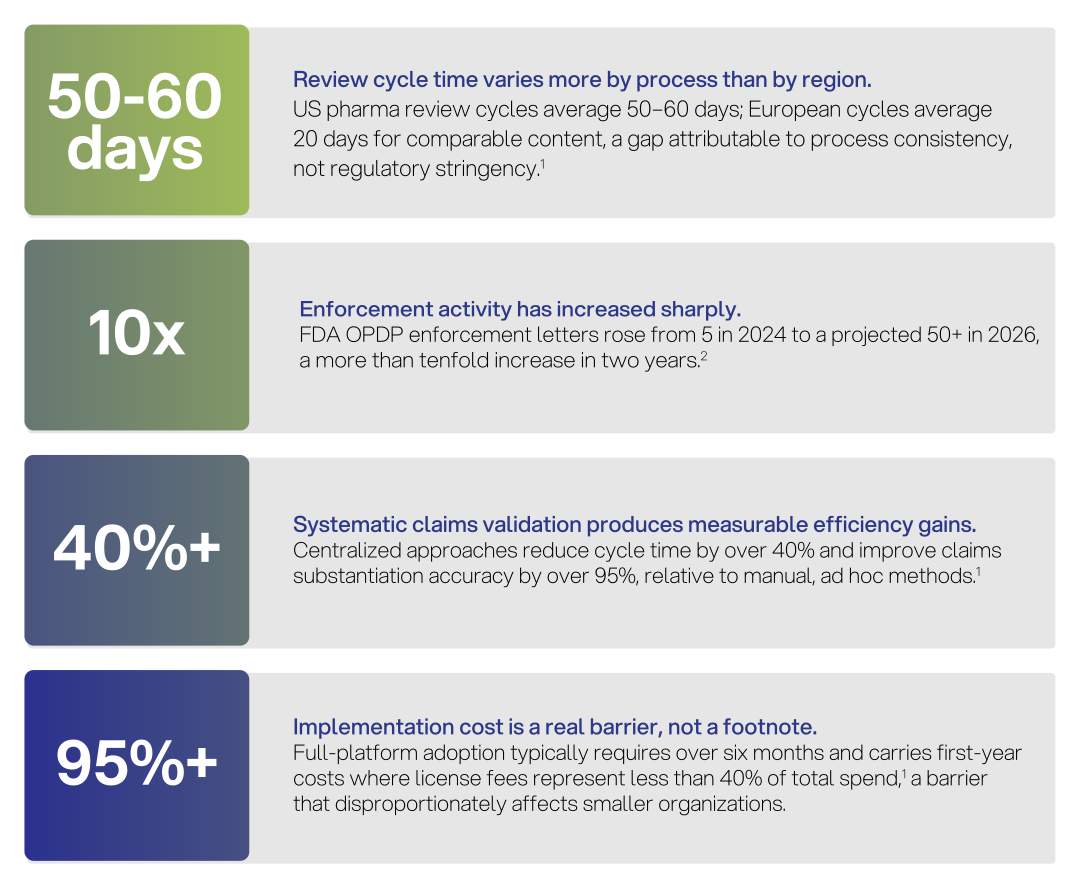
- Review cycle time varies more by process than by region. US pharma review cycles average 50–60 days; European cycles average 20 days for comparable content, a gap attributable to process consistency, not regulatory stringency [1].
- Enforcement activity has increased sharply. FDA OPDP enforcement letters rose from 5 in 2024 to a projected 50+ in 2026, a more than tenfold increase in two years [2].
- Systematic claims validation produces measurable efficiency gains. Centralized approaches reduce cycle time by over 40% and improve claims substantiation accuracy by over 95%, relative to manual, ad hoc methods [1].
- Implementation cost is a real barrier, not a footnote. Full-platform adoption typically requires over six months and carries first-year costs where license fees represent less than 40% of total spend [1], a barrier that disproportionately affects smaller organizations.
Overview of M+L+R Review
MLR stands for Medical, Legal, Regulatory review. Some organizations use the term PRC, for Promotional Review Committee. Others refer to it as technical review or compliance sign-off. The terminology varies by organization, but the function is consistent [3].
Before a marketing content is published, it passes through review by three functions. Medical evaluates scientific accuracy. Legal evaluates risk exposure. Regulatory evaluates compliance with applicable guidelines. Approval requires alignment across all three [3].
Every claim within that content must be traceable to supporting evidence, whether a clinical study, a data sheet, or a trial result. This traceability requirement is the basis of the review process [3].
The Traditional Process Where the Bottleneck Begins
In most organizations, claims verification is performed manually. A reviewer opens the content, opens the corresponding reference, and checks whether the two align. This is repeated for each individual claim [4].
Review typically proceeds sequentially: Medical reviews first, followed by Legal, followed by Regulatory. Each function waits for the prior one to complete before beginning its own assessment [4]. A change requested at any stage can require the asset to re-enter the queue [5].
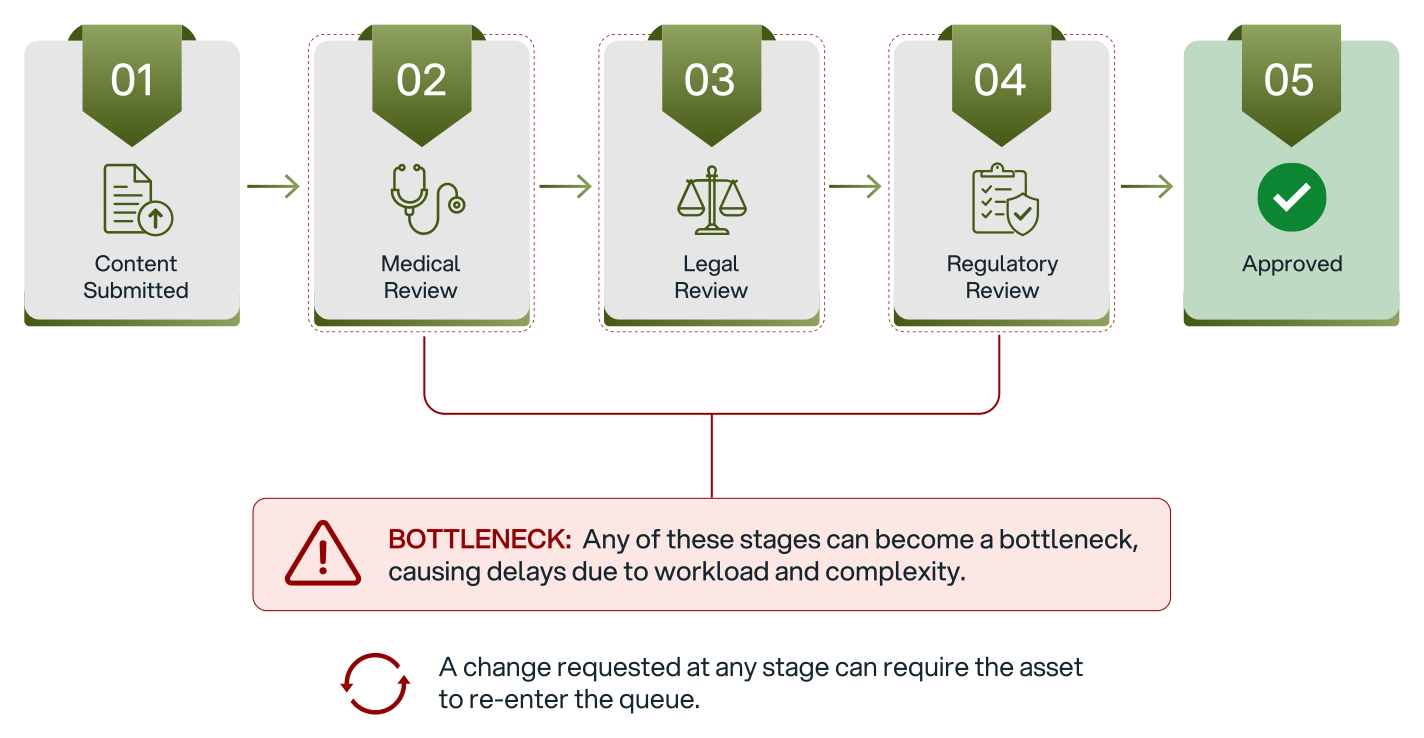
Tracking is commonly done through spreadsheets and email. These tools can confirm that a claim exists. They cannot confirm that the claim is accurate [4].
This is the structural bottleneck: not a deficiency in reviewer diligence, but the absence of a system designed to verify claims systematically.
Where the Delay Occurs
Review delay is rarely attributable to a single cause. The following factors, documented across independent sources, account for most of it.
Structural Causes of Delay
- Claims traceability: Verifying that each claim is backed by the correct reference, in the correct context, is typically performed manually. Global launches now require content adapted for 20+ regulatory jurisdictions, on average 30% more complex than five years ago. Digital asset volume is rising 50% year-over-year at many organizations [1].
- Coordination: Medical, legal, and regulatory review typically occurs sequentially rather than in parallel. Feedback is distributed across multiple formats with no single point of consolidation, and version control is a recurring source of delay [4].
- Process: Existing tools such as spreadsheets and email track that a claim exists but do not verify it, and do not preserve an audit trail.
- Iterative rework: A single asset may pass through three or more partial review cycles, often with no continuity between reviewers [5].
- Reference verification at the review stage: Reviewer time is frequently spent correcting citation errors rather than exercising scientific or regulatory judgment [5].
- Diminishing returns from additional reviewers: Adding reviewers increases coordination overhead at a rate that can offset any gain in review capacity [5].
- Absence of a pre-approved claims library: Every campaign starts claims verification from zero, without a system to reuse claims that have already cleared review [6].
Table 1. Documented causes of delay in MLR review [1, 4, 5, 6].
| Cause | Where the Time Goes |
|---|---|
| Incomplete submissions | Reviewer reconstructs missing context before assessment can begin |
| Version inconsistency | A full review cycle lost to administrative correction alone |
| Reviewer capacity constraints | Simultaneous demand across launches, conferences, campaigns |
| Unresolved messaging strategy | MLR becomes the venue for positioning debate, not verification |
| Iterative rework | 3+ partial cycles, often with no continuity between reviewers |
| Reference verification at review stage | Reviewer time spent on citation checking, not judgment |
| Diminishing returns from more reviewers | Coordination overhead can offset added capacity |
| Reviewer turnover | Institutional knowledge of past decisions is not retained |
Collectively, these factors explain observed review-cycle benchmarks: 50 to 60 days for a single asset in the United States, compared to approximately 20 days in Europe for comparable content [1]. The difference reflects process consistency, not regulatory stringency [1].
What This Delay Costs
The cost of review delay extends beyond internal timelines.
For the organization, campaign and launch windows are time sensitive. Extended review can result in content reaching the market after its intended commercial window has narrowed or closed. A 30–40-day gap between US and European review cycles represents recoverable time directly tied to launch timing [1].
Implementation of systematic validation tooling carries its own cost profile: license fees represent less than 40% of first-year investment, with the remainder driven by validation, data migration, and integration, typically completed over six months or more. This is a documented barrier for small and mid-sized organizations without dedicated IT infrastructure [1].
Delay and enforcement risk are not contained to the organization issuing the content. Two downstream effects are relevant: timely availability of accurate information to healthcare professionals and patients, and reputational exposure from public enforcement action.
Delay is also compounding at the portfolio level. Industry data indicates that approximately one in four content pieces requires at least one additional review cycle before approval [7]. Across a portfolio of ten simultaneous campaigns, this produces an estimated 95% probability that at least one will require rework [7].
What Happens When Review Is Not Rigorous
When claims are insufficiently verified, content can reach the public before its accuracy has been fully confirmed.
In 2025, the FDA's Office of Prescription Drug Promotion (OPDP) issued more than 200 enforcement letters related to drug advertising and promotion. Only five had been issued prior to September 9, 2025. Of the 200 letters, 74 were directed specifically at pharmaceutical and biologic manufacturers, which included 10 Warning Letters and 64 Untitled Letters [8]. This coordinated enforcement action resulted in more than 100 letters issued in a single day [8, 2]. As of March 2026, OPDP issued at least nine letters for the year, making the count to exceed 50 letters total, compared to only five in all of 2024 [2].
Case example: In January 2026, OPDP issued an Untitled Letter concerning promotional material citing a survival rate and a response rate. The claims made, were not adequately supported by the underlying trial data [9]. The data cited was accurate; the presentation overstated what a single-arm trial could support.
Table 2. FDA OPDP enforcement cases from 2025-2026 across a range of companies, products, and content formats [8, 9, 10].
| Company / Product | Date | Issue |
|---|---|---|
| Edenbridge Pharmaceuticals (Dexcel) / Hemady | Feb 2025 | Exhibit booth panel misrepresented risk-benefit profile |
| Taiho Oncology / Lytgobi | Mar 2025 | Website overstated efficacy (PFS, OS, disease control rate) |
| Mayne Pharma / Nextstellis | Apr 2025 | Untitled Letter, oral contraceptive promotional claims |
| Sprout Pharmaceuticals / Addyi | Jun 2025 | Warning Letter (escalated tier) |
| AstraZeneca | Sep 2025 | 5 separate letters |
| Novartis | Sep 2025 | 4 letters |
| UCB, Phathom Pharmaceuticals, Boehringer Ingelheim | Sep 2025 | 3 letters each |
| Takeda, BMS, AbbVie, Teva Neuroscience, Supernus | Sep 2025 | 2 letters each |
| BridgeBio Pharma / Attruby | Sep 2025 | Voiceover ad found to mislead on quality-of-life claims |
| ImmunityBio / Anktiva | Sep 2025, Jan 2026, Mar 2026 | Two Untitled Letters, then a Warning Letter when claims were not corrected |
| Pfizer / Adcentris | 2026 | Facebook video ads |
| Amneal Pharmaceuticals; BioCorRx Pharmaceuticals | 2026 | Untitled Letters in the same enforcement wave |
Across these cases, the underlying data was typically factually correct. But its presentation exceeded what that data could substantiate. A claim technically traceable to real evidence, worded in a way the evidence did not fully support [8-10].
A peer-reviewed analysis of FDA warning letters found that omission of risk information was the most frequently cited violation. This accounted for nearly one-third of all violations identified. Unsubstantiated efficacy claims were the second most frequent [11].
Cost Impact: Organizational and Downstream
Direct Organizational Cost
Delay has a direct commercial cost: a 30-40-day gap between US and European review cycles represents recoverable time directly tied to launch timing and campaign windows. Implementation of systematic validation tooling carries its own cost profile; license fees represent less than 40% of first-year investment, with the remainder driven by validation, data migration, and integration, typically completed over six months or more. This cost structure is a documented barrier for small and mid-sized organizations without dedicated IT infrastructure [1].
Downstream Impact
Delay and enforcement risk are not contained to the organization issuing the content. Two downstream effects are relevant: timely availability of accurate information to healthcare professionals and patients, and reputational exposure from public enforcement action.
Is There a Simpler Way?
A simple way is to verify the claims before they reach the signatory authorities.
The data in previous sections support three requirements for an effective claim validation approach. It must occur earlier in the content lifecycle, function systematically rather than ad hoc, and be accessible without a multi-month implementation.
Adoption of software enabled tools for better verifications, a hassle-free self-review before the content reaches the authority.
A data point concerns pre-review error detection specifically. AI-assisted pre-review capabilities are reported to identify up to 70% of common compliance errors, including missing fair-balance language and unsubstantiated claims, before content reaches formal review [1]. A substantial share of the errors that currently surface for the first time during MLR or PRC review are, in principle, detectable earlier.
According to surveys, leading countries are now adopting faster and technologically advanced ways for claims verification. Regional adoption confirms this shift is already underway.
Review cycles for content in mid-to-large pharma organizations in the US commonly run 50–60 days. European (UK, Germany, and France) cycles average approximately 20 days, with 1.3 review cycles per asset. The gap is unlikely to reflect looser regulatory standards in Europe; a more plausible explanation is process consistency, specifically how systematically claims are checked prior to formal review, consistent with the deployment-model and AI-pre-review findings above. APAC (China, India, and Japan) is currently the fastest-growing region globally for MLR and claims-review software adoption (11.8% CAGR), ahead of North America (10.7%) and the global average (11.1%) [1].
Vero
Vero is the Simpler Way!
Vero was developed at ethosh to address this gap directly. It is a content compliance and lifecycle platform that helps Pharma, Medtech, and Labtech teams store approved content, validate claims faster and generate new content that's compliant from the first draft. It consists of three components, each addressing a distinct part of the claim's verification process.
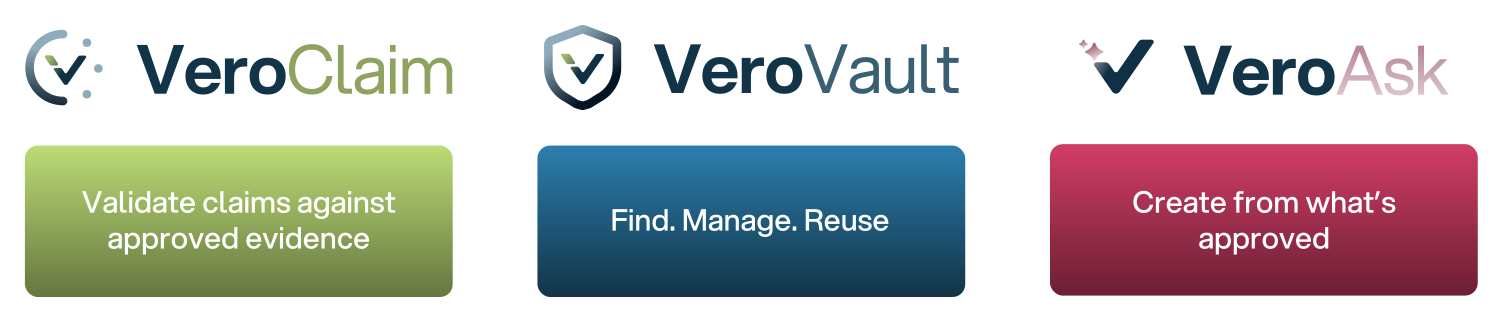
- VeroVault: A central library of approved content. Instead of re-verifying claims that have already been validated, teams can locate and reuse existing, approved material.
- VeroClaim: Automated claim validation. VeroClaim identifies claims within content, extracts them, links them to existing approved evidence where available, and validates them against new or existing evidence. It surfaces this analysis directly to the reviewer.
- VeroAsk: An AI assistant that generates new content grounded in the approved content library, using AI-powered question-answering and content generation.
Vero supports both sides of the review process. For uploaders, VeroClaim automatically identifies and validates claims, reducing the need to manually link each claim to its supporting evidence. This means content can be submitted with greater confidence, knowing the claims have already been checked.
For reviewers, those pre-validated claims are visible upfront, so they can focus on reviewing the content, adding comments, and providing feedback rather than starting the validation process from scratch.
Benefits and Capabilities
Vero's role is to do the mechanical work of claims verification, saving reviewers' time and not replacing them. It surfaces everything they need directly inside their existing review process. Its core function consists of five steps.
- Claims identification: VeroClaim reads through submitted content and identifies every individual claim within it, so no claim is missed or left unchecked just because a reviewer's attention moved on to the next section.
- Extract claims: Each identified claim is pulled out as a discrete, checkable unit, separate from the surrounding content. This turns a dense document into a clear list of specific statements that each need their own verification.
- Linking claims to existing evidence: Where an approved claims library already exists, VeroClaim links each extracted claim to the corresponding evidence already on file, so a reviewer isn't re-verifying something that has already been checked and cleared.
- Validates claims against new or existing evidence: For claims without a prior match, VeroClaim checks them directly against the reference material provided. It confirms whether the source supports the claim as worded, not just whether a citation exists.
- Surfaces the analysis to the reviewer: Above all, identification, extraction, linkage, and validation is presented directly to the reviewer inside their workflow, saving them the time they would otherwise spend doing this manually, claim by claim.
- Centralized library of approved content: VeroVault, the centralized vault of approved content that teams can easily access, eliminates repetitive verifications and speeds up the development and MLR review.
What Difference Will Vero Bring
Everything in this paper points to the same conclusion.
Claims verification needs to happen earlier, more consistently, and without rework.
Vero was built around that exact requirement; it acts as an assistant to the reviewer, helping speed up the work and make the review process easier.
Vero can identify and extract claims, link them to existing claims in the approved library where available, and validate them against existing or newly provided evidence. It then surfaces all of this context to the reviewer, so they don't have to start from scratch.
The reviewer still makes the final call. Vero simply does the groundwork, so reviewers can spend less time finding and validating evidence and more time reviewing the content itself.
What Sets Vero Apart
Vero is not a general-purpose compliance platform adapted for life sciences. It is purpose-built for the specific shape of this problem.
- Automated claim extraction, linking, and validation: Claims are identified and checked automatically, then linked to the respective references, rather than located and verified one by one, by hand.
- Country-specific regulatory guidelines: Built-in awareness of jurisdictional variation, relevant given that a single global launch can now require content adapted for 20+ regulatory jurisdictions [1].
- Approved content, versions, and expiry, tracked together: Addresses the version-confusion problem directly, one of the most consistent causes of delay identified in previous sections.
- No enterprise migration, no starting from scratch: Vero is designed to sit alongside an organization's existing review process, not replace it, consistent with how Vero has been positioned throughout this paper, as an assistant to the reviewer, not a gate ahead of them.
Built for the Work Life Sciences Teams Actually Do
Vero was built with an intent. Purpose-built for Pharma, MedTech, and Diagnostics promotional content specifically, not adapted from a generic compliance tool.
With Vero, every claim is backed by traceable scientific evidence, directly addressing the contextual-accuracy gap identified across the FDA case studies.
Faster decisions reduce manual review effort and accelerate claim validation workflows rather than adding another step to them. From extraction to validation, every claim is processed with accuracy and transparency, regardless of which reviewer or which day.
Vero includes simple, intuitive workflows that fit naturally into existing review processes, rather than requiring teams to learn a new one. Designed to grow with an organization through automation, and enterprise integrations for teams of any size.
The Impact
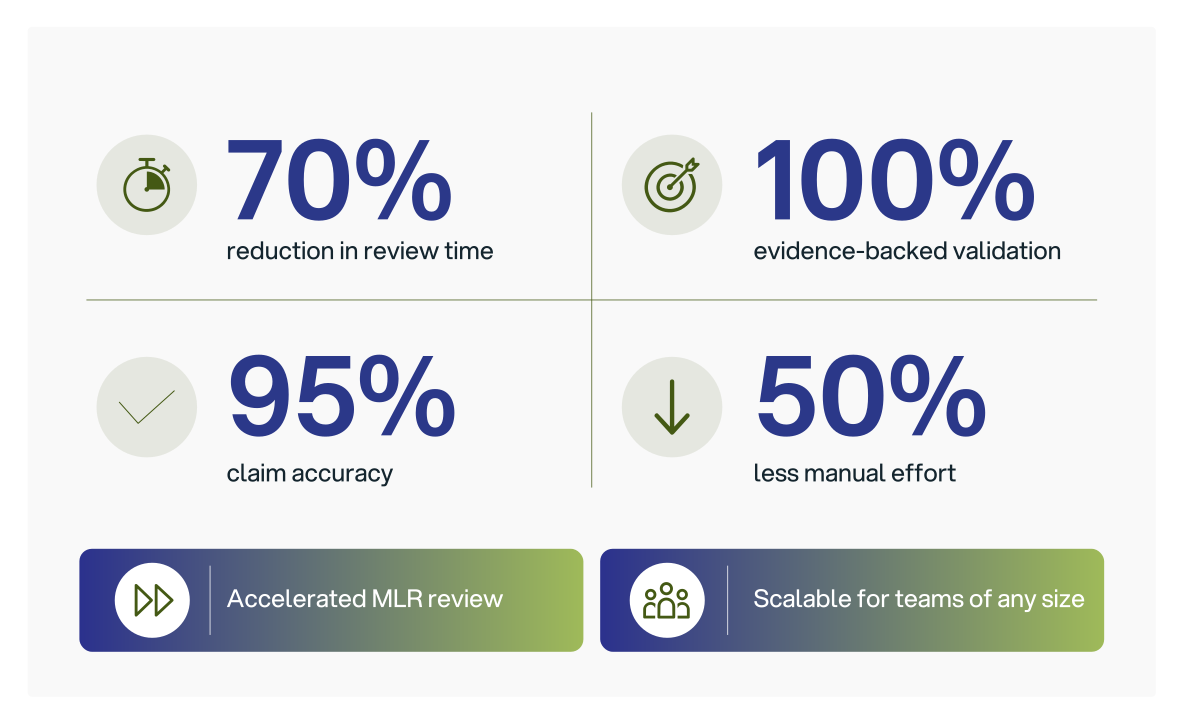
- 70% reduction in review time
- 100% evidence-backed validation
- 95% claim accuracy
- 50% less manual effort
- Accelerated MLR review
- Scalable for teams of any size
The result is straightforward: less review, more creation. Faster content cycles. Evidence-backed content by default. Compliance built into the workflow, rather than checked for at the end of it.
Conclusion
The data presented in this paper indicate that manual claims verification is a primary driver of both review-cycle delay and enforcement risk in life sciences marketing content, independent of organization type or region.
The cost is measurable at every stage. This is the specific problem Vero is built to solve. It does not ask a team to replace their review process or wait months before seeing value. VeroClaim identifies, extracts, links, and validates claims from the first use, and surfaces that work directly to the reviewer, inside the review they are already doing. VeroVault removes the need to re-verify what has already been approved. VeroAsk ensures new content starts from what has already been validated, rather than starting from zero.
The choice in front of life sciences marketing and regulatory teams is no longer whether systematic claims validation is worth adopting. The data in this paper settles that question. The choice is whether to keep absorbing the cost of manual review, cycle after cycle, or to close the gap now, with a tool built to work alongside the reviewer.
References
- Technavio, Medical, Legal, And Regulatory (MLR) Review Software Market Analysis, Size, and Forecast 2026–2030, May 2026.
- Sidley Austin LLP, New U.S. FDA Letter Contradicts Decades-Old Precedent on Prescription Drug Promotion.
- Pulse Health, MLR Pharma Explained: Workflow, Stages, Common Delays.
- Pulse Health, MLR Review Process in Pharma: How Teams Reduce Bottlenecks Without Slowing Content Delivery.
- The Promo Review, What Actually Slows Down MLR Review.
- Valuebound, MLR Healthcare: How to Cut Approval Time in Half.
- Klick Health, From Checkpoint to Input: A Different Model for MLR.
- King & Spalding, 2025 Year in Review: FDA Drug and Device Advertising and Promotion Enforcement.
- Gardner Law, OPDP's 2026 Untitled Letters: Early Enforcement Trends in Prescription Drug Promotion.
- RAPS (Regulatory Affairs Professionals Society), FDA Posts More Than 100 Warning and Untitled Letters, corroborated by Fierce Pharma.
- Chatterjee S, Patel HK, Sansgiry SS, An Analysis of the Warning Letters Issued by the FDA to Pharmaceutical Manufacturers Regarding Misleading Health Outcomes Claims, Pharmacy Practice, 2012.
Appendix
A. Glossary
- MLR: Medical, Legal, Regulatory (review)
- PRC: Promotional Review Committee
- OPDP: Office of Prescription Drug Promotion (FDA)
- CAGR: Compound Annual Growth Rate
We would love to hear your thoughts about this white paper or request a Vero demo.